

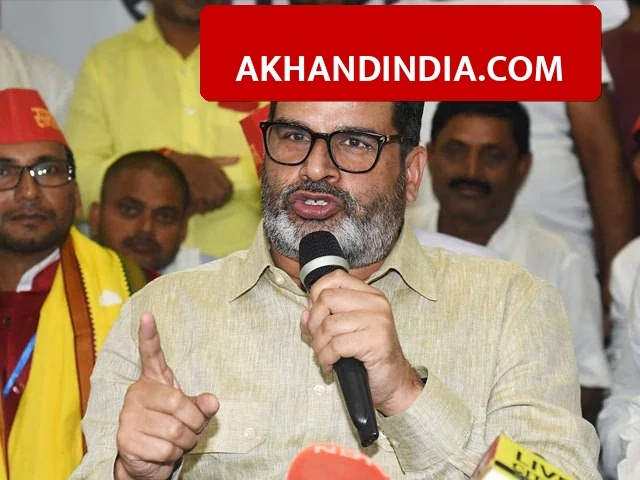

The Supreme Court of India on Friday refused to accept a petition filed by the Jan Suraaj Party that demanded the cancellation of the 2025 Bihar Assembly elections. A bench led by Chief Justice Surya Kant dismissed the plea and stated that such matters should be handled through individual election petitions. The court questioned the party’s intent and remarked that political parties often turn to the court system for support after being rejected by the voters during elections.
👉: Bihar Govt Approves Rs 1302 Crore for Sonpur Greenfield Airport, 4228 Acres Land Acquisition Starts।
Why did the Supreme Court reject the plea?
The bench comprising Chief Justice Surya Kant and Justice Joymalya Bagchi expressed strong disapproval of the petition. They noted that the move seemed to be an attempt to gain publicity rather than a genuine legal grievance. The judges asked the petitioner how many votes the party had actually received in the election before approaching the court. The Chief Justice clarified that an entire state election cannot be challenged through a simple writ petition after the results are out.
The court emphasized that the proper legal remedy for challenging election results is to file specific election petitions for individual seats. The bench stated that the judicial forum should not be used to overturn a decisive mandate given by the public. The dismissal marks a significant moment for the newly formed party which had contested 238 seats in the assembly elections.
What were the allegations made by Jan Suraaj?
The petition filed by Prashant Kishor’s party claimed that the ruling government in Bihar had violated the Model Code of Conduct. The party alleged that the fairness of the election was compromised due to specific government schemes implemented right before the polls.
- The plea cited the distribution of funds under the ‘Mukhyamantri Mahila Rojgar Yojana’.
- It claimed that money was given to approximately 1.56 crore women voters.
- The party argued this created an unfair advantage and demanded fresh elections for all 243 seats.
The Supreme Court, however, did not entertain these arguments in the form of a writ petition and maintained that the electoral verdict must be respected unless challenged through the correct legal procedures for specific constituencies.
